
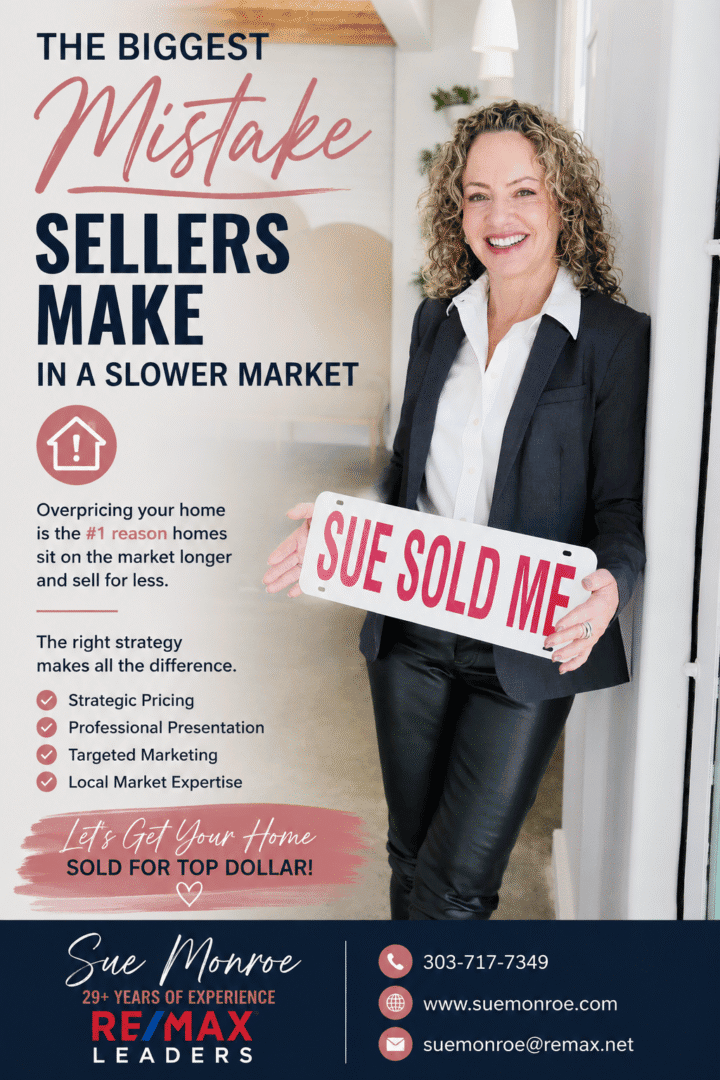
The Biggest Mistakes Home Sellers Are Making Right Now — And How to Avoid Them
Selling a home in Colorado today is different than it was a few years ago.
Buyers have more choices, they’re paying close attention to price, and higher mortgage rates have made affordability a major consideration. That means sellers can’t necessarily use the same strategy that worked when homes were selling quickly and multiple offers were common.
After more than 29 years in real estate with RE/MAX, I’ve seen many different types of markets. One thing I’ve learned is that sellers who understand the market and price and prepare their home strategically usually put themselves in a much stronger position.
Here are some of the biggest mistakes I see sellers making right now.
1. Overpricing the Home “Just to See What Happens”
This is one of the biggest mistakes sellers can make.
It’s understandable. You want to get the highest possible price for your home, especially after years of significant appreciation.
But today’s buyers are more educated than ever. They can easily compare your home with other properties online, look at recent sales and see how long homes have been sitting on the market.
If your home is overpriced, buyers may simply skip it.
And once a home sits on the market for an extended period, sellers can find themselves having to reduce the price anyway — sometimes more than they would have needed to if they had priced correctly from the beginning.
The goal isn’t to price your home as high as possible. The goal is to price it correctly based on today’s market.
2. Pricing Based on What Your Neighbor Got
Your neighbor may have sold for $700,000.
That doesn’t necessarily mean your home is worth $700,000.
Even homes on the same street can have significant differences in condition, updates, lot size, floor plan, location within the neighborhood, views, finished square footage and many other factors.
A good pricing strategy looks at comparable homes and, just as importantly, considers what buyers are seeing on the market right now.
Your home’s value isn’t determined by what you need to make, what you paid for it or what your neighbor received.
It’s determined by what today’s buyers are willing to pay.
3. Ignoring the Competition
One of the most important questions I ask sellers is:
“What will buyers be comparing your home to?”
Your home isn’t competing against homes that sold six months ago. It’s competing against the homes buyers can see today.
If there are several similar homes for sale in your price range, buyers have choices.
That means your home needs to stand out through a combination of price, condition, presentation and marketing.
4. Thinking Buyers Will Just “Lowball” You
Some sellers are reluctant to price their home competitively because they’re afraid buyers will make ridiculously low offers.
But in many cases, today’s buyer isn’t looking at an overpriced home and thinking, “I’ll just offer $50,000 less.”
They may simply move on to another property.
That’s why getting the price right from the beginning is so important.
A well-priced home can attract more attention and potentially create stronger negotiating opportunities than an overpriced home that sits on the market.
5. Spending Too Much Money on Renovations Before Selling
Another mistake I see is sellers thinking they need to completely remodel their home before putting it on the market.
You may not.
A major kitchen renovation, expensive bathroom remodel or other large project doesn’t automatically mean you’ll get that money back when you sell.
Before spending thousands of dollars, talk with an experienced Realtor about what actually matters to buyers in your market.
Sometimes the best investment is not a major renovation. It may be decluttering, deep cleaning, making a few strategic repairs and presenting the home well.
6. Thinking “The House Shows Great, So That’s Enough”
Your home can look wonderful in person and still struggle to attract buyers if the online presentation isn’t strong.
Most buyers begin their search online.
That means professional-looking photography, an appealing listing description, accurate pricing and a strong marketing strategy are extremely important.
Your listing needs to make a buyer want to schedule a showing.
7. Taking Every Comment From a Buyer Personally
Selling your home can be emotional.
You’ve lived there. You’ve raised your family there. You’ve made memories there.
But buyers don’t have that emotional connection.
They may walk into a home and immediately notice things you don’t see anymore.
That doesn’t necessarily mean they don’t like your home. It means they’re evaluating it as a purchase.
Seller feedback can be useful when it’s looked at objectively.
If several buyers independently mention the same issue, it’s worth paying attention.
8. Refusing to Consider Seller Concessions
Today’s market isn’t only about the sales price.
Buyers are also thinking about their monthly payment and the amount of cash they need to bring to closing.
Depending on the situation, a seller concession could help a buyer with eligible closing costs or a mortgage rate buydown.
Sometimes accepting a reasonable concession can make a home more attractive to a buyer and help get the transaction closed.
The important thing is to look at the entire offer, not just the purchase price.
9. Waiting for the “Perfect” Market
I hear this question frequently:
“Should I wait until the market gets better?”
The problem is that nobody knows exactly when the perfect market will arrive.
If you’re thinking about selling, the better question may be:
“What can I do to make my home competitive in the market we have today?”
There will always be reasons to wait.
Interest rates could change. Inventory could change. Home prices could change. The economy could change.
Your personal circumstances should be part of the decision, too.
10. Choosing an Agent Based Only on the Highest Suggested List Price
This is a big one.
If one agent tells you your home is worth $650,000 and another says $725,000, it can be tempting to choose the agent promising the highest price.
But a high suggested list price doesn’t guarantee a high sales price.
Ask the agent:
- How did you determine this price?
- What comparable sales are you using?
- What are the competing homes currently listed for?
- What is your marketing strategy?
- How will we respond if the home doesn’t receive offers?
- What is your communication process?
- Who will actually be handling my transaction?
Experience matters, particularly when market conditions aren’t as easy as they were a few years ago.
The Bottom Line
Selling a home in today’s Colorado market requires more strategy than simply putting a sign in the yard and waiting for a buyer.
Price it correctly. Prepare it strategically. Market it well. And be willing to adjust based on what the market is telling you.
After more than 29 years with RE/MAX, I’ve learned that every seller’s situation is different. There is no one-size-fits-all strategy.
If you’re considering selling your Colorado home, I’d be happy to help you understand what your home could realistically sell for, what — if anything — is worth doing before listing, and how to position your home to attract today’s buyers.
Sue Monroe
RE/MAX Leaders
Over 29 Years of Real Estate Experience
303-717-7349
suemonroe@remax.net
www.suemonroe.com
Real estate decisions are specific to each property and situation. A professional market analysis and advice from an experienced real estate professional can help you determine the best strategy for your home.